Check out myself and Alex Pyne of Blue Bottle Independent Union discussing union organizing in the cafe sector the other week, and Kevin Van Meter and Robert Ovetz discussing resurgent labor organizing this week.
Economisting Blog
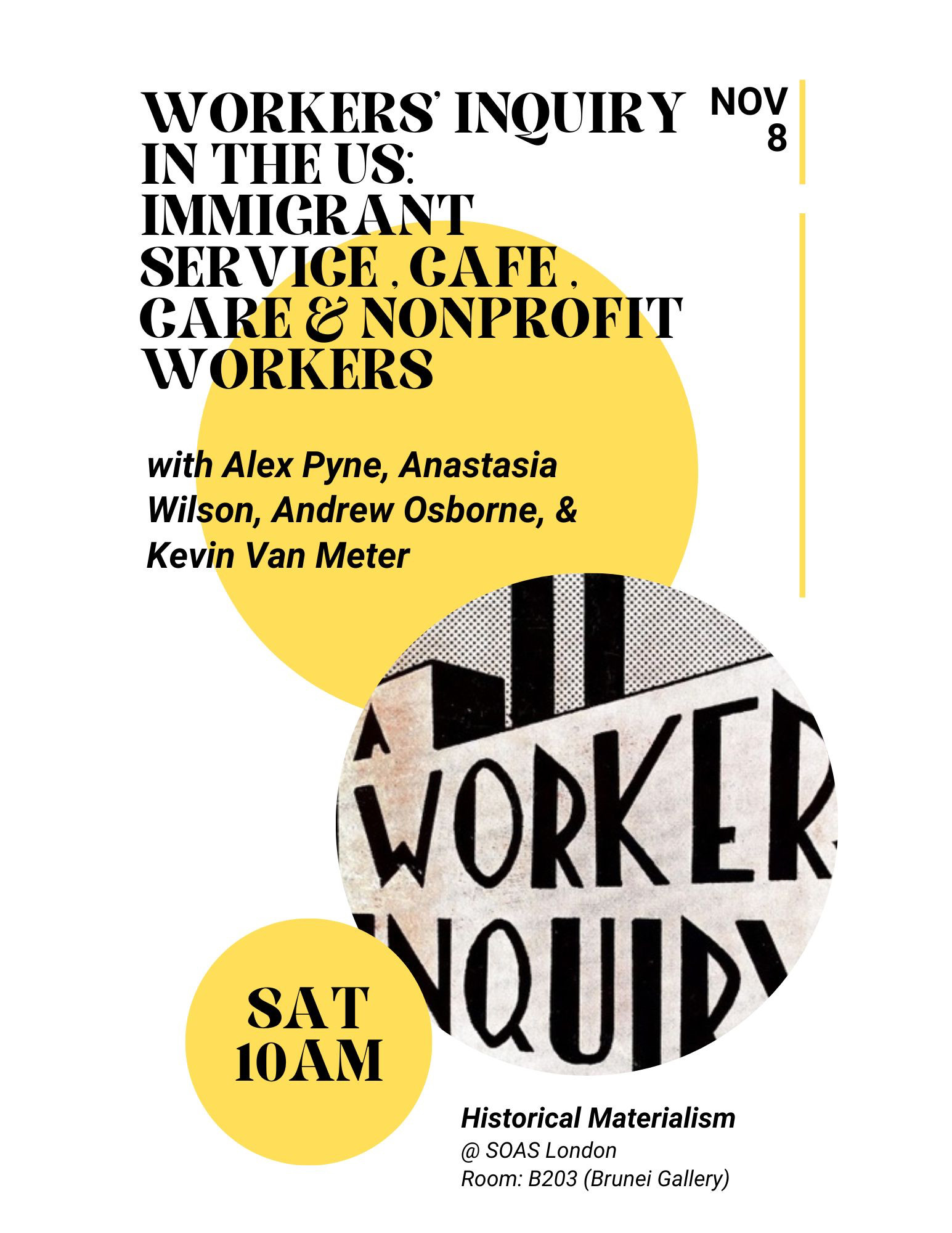
workers’ inquiry and BBIU at HM
catch us at historical materialism in london this weekend chatting and scheming about our projects
workers’ inquiry on librarypunk podcast
library punk invited Blue Bottle Indie Union and comrades to chat about class composition in the café sector and the method of workers’ inquiry. have a listen. let many inquiries bloom!
Class Composition in the Café Sector –> Notes from Below
““It fucks with my body.” “It’s stressful and exhausting.” “My feet hurt from standing too long.” “We don’t get to just sit down sometimes and are expected to always be moving,” as respondents to our survey reflected.1 The circuits of capitalist accumulation also circulate through our bodies. This is even more true for those in the service sector and working in cafes. It is in these workplaces that we begin our inquiry.”
Read more of our workers’ inquiry with Blue Bottle Independent Union and Kevin Van Meter on the Notes from Below website. Grateful to our comrades for publishing our inquiry.
Part 1 of Class Composition in the Café Sector gives an analysis of class composition the café sector based on survey responses and one-on-one interviews. We ask “what do café workers think about and do at work?”, and look at issues of triangulation between front and back of house, workers’ control of the labor process, wages, and safety at work.
Part 2 of Class Composition in the Café Sector looks at café worker self-activity and self-organization in the sector, including examples of recent organizing and strike activity, and a discussion of workplace democracy and self-management.
Are you a cafe worker?
As the next step in our inquiry, we are circulating “Class Composition in the Cafe Sector” for further comment, interviewing organizers, holding release events, and publishing our collected findings. Blue Bottle Independent Union and Workers Inquiry Dot Work invite café workers to respond to our findings at www.workersinquiry.work with the following prompts with 250-500 words by September 15, 2025.
- What resonated and didn’t resonate with you?
- How are you and your coworkers organised informally at work? How do you communicate, and show solidarity and mutual aid with each other?
- What are your current organising goals? What is the organizing plan like how will you make decisions?
workersinquiry.work
we’ve got a linktree set up for workersinquiry.work with contact info and a link to our class composition in the café sector survey!
café workers’ inquiry zine
linking the zine put together by BBIU comrades from our workers’ inquiry project, class composition in the café sector. you can find the zine UNFILTERED Bitter Thoughts On Cafe Work at workersinquiry.work
updates for spring
someday i’ll get better at actually using this space to write, but meanwhile some updates. im enjoying every bit of teaching this semester, with courses on debt, political economy, and macroeconomics. im scheming projects and finishing up some work on collective care.
i’ll be at the umass labor center strike conference talking about workers’ inquiry with my pals kevin van meter and the blue bottle indie union.
hoping to attend the carceral political economy conference at the new school too, organized by some very rad folks.
and im grateful to the association for social economics for funding some new research on collective care. ❤
new book review: family abolition
i wrote a book review of Family Abolition: Capitalism and the Communizing of Care for Feminist Economics. you can read it here. (you can email me for a copy if unable to access).
tl;dr everyone should read this book, especially feminist economists. and then think more carefully about what we mean by “care”.
saturday night reading/watching
society of the spectacle
“in the spectacle, there is no such thing as unproductive labor. all work is productive, because as long as people are doing it, they produce the spectacle, and can’t produce anything else.”
in and against care work syllabus
In and Against Care Work Syllabus –Anastasia C. Wilson (awilson@hws.edu)
suggestions welcome ❤
The Limits of the Family
The Anti Social Family
Family Abolition
Full Surrogacy Now
Capitalism and Care
Care the Highest Stage of Capitalism
Depletion
Patriarchy and Accumulation on a World Scale
The Care Crisis
Anti-Work and Care
The Problem with Work
Women and the Subversion of the Community
Revolution from Point Zero
Care In and Against the State
Women and the Welfare State
Women’s Paid and Unpaid Labor
Family, Welfare, and the State
The Local State: Management of Cities and People
In and Against the State
In and Against the Care Economy
Forced to Care
Feminist Subversion of the Economy
Care Manifesto
Disability Justice, Mental Health, and Health Autonomy
Care Work: Dreaming of Disability Justice
A People’s Guide to Abolition and Disability Justice
For Health Autonomy Carenotes Collective
Storming Bedlam
Abolition, Social Work, and Care
Abolition and Social Work
Checkerboard Square
Torn Apart
Bibliography
Barrett, Michèle, and Mary McIntosh. The Anti-Social Family. Second edition. Radical Thinkers. Brooklyn, NY: Verso, 2015.
CareNotes Collective, ed. For Health Autonomy: Horizons of Care beyond Austerity: Reflections from Greece. Brooklyn, NY: Common Notions, 2020.
Cockburn, Cynthia. The Local State: Management of Cities and People. Repr. London: Pluto Press, 1980.
Conference of Socialist Economists. In and against the State: Discussion Notes for Socialists. Edited by Seth Wheeler. New edition. London: Pluto Press, 2021.
Dalla Costa, Mariarosa, and Rafaella Capanna. Family, Welfare, and the State: Between Progressivism and the New Deal. Brooklyn, NY: Common Notions, 2015.
Dalla Costa, Mariarosa, Harry Cleaver, and Camille Barbagallo. Women and the Subversion of the Community: A Mariarosa Dalla Costa Reader. Oakland, CA: PM, Press, 2019.
Dowling, Emma. The Care Crisis: What Caused It and How Can We End It? First edition paperback. London ; New York: Verso, 2021.
Federici, Silvia. Revolution at Point Zero: Housework, Reproduction, and Feminist Struggle. Oakland, Calif: PM Press, 2012.
Glazer, Nona Y. Women’s Paid and Unpaid Labor: The Work Transfer in Health Care and Retailing. Women in the Political Economy. Philadelphia: Temple Univ. Press, 1993.
Glenn, Evelyn Nakano. Forced to Care: Coercion and Caregiving in America. Cambridge, Massachusetts: Harvard University Press, 2012.
Kim, Mimi E., Cameron Rasmussen, and Durrell M. Washington, eds. Abolition and Social Work: Possibilities, Paradoxes, and the Practice of Community Care. Chicago: Haymarket Books, 2024.
Lewis, Sophie. Full Surrogacy Now: Feminism against Family. London: Verso, 2019.
Mies, Maria. Patriarchy and Accumulation on a World Scale: Women in the International Division of Labour. New ed. London: Zed Books, 2001.
Nadasen, Premilla. Care: The Highest Stage of Capitalism. Chicago: Haymarket Books, 2024.
O’Brien, M. E. Family Abolition: Capitalism and the Communizing of Care. London ; Las Vegas, NV: Pluto Press, 2023.
Pérez Orozco, Amaia. The Feminist Subversion of the Economy: Contributions for Life against Capital. Translated by Liz Mason-Deese. Brooklyn, NY Philadelphia, PA: Common Notions, 2022.
Piepzna-Samarasinha, Leah Lakshmi. Care Work: Dreaming Disability Justice. Vancouver: Arsenal Pulp Press, 2018.
Rai, Shirin. Depletion: The Human Costs of Caring. New York, NY: Oxford University Press, 2024.
Roberts, Dorothy E. Torn Apart: How the Child Welfare System Destroys Black Families–and How Abolition Can Build a Safer World. First edition. New York: Basic Books, 2022.
Tastrom, Katie. A People’s Guide to Abolition and Disability Justice. Oakland, CA: PM Press, 2024.
The Care Collective, Andreas Chatzidakis, Jamie Hakim, Jo Littler, Catherine Rottenberg, and Lynne Segal, eds. The Care Manifesto: The Politics of Interdependence. London ; New York: Verso Books, 2020.
Wagner, David. Checkerboard Square: Culture and Resistance in a Homeless Community. Boulder: Westview Press, 1993.
Warren, Sasha. Storming Bedlam: Madness, Utopia, and Revolt. Brooklyn: Common Notions, 2024.
Weeks, Kathi. The Problem with Work: Feminism, Marxism, Antiwork Politics, and Postwork Imaginaries. A John Hope Franklin Center Book. Durham, N.C. London: Duke University Press, 2011.Wilson, Elizabeth. Women & the Welfare State. Repr. Social Science Paperbacks 177. London: Tavistock, 1987.
 anastasia c. wilson